Deptford Bridge • 17 June 1497
How a Cornish tax revolt ended up in Deptford
On a grey June morning in 1497, a tired Cornish army — miners, farmers, and minor gentry — stood facing Henry VII’s troops across the bridge at Deptford, a few miles south of London. They’d marched from the far end of England to protest new taxes for a Scottish war that wasn’t theirs. What began as a row over money had turned into open rebellion. Now, on the edge of London, their anger was about to meet the king’s army.
For a trained eye, the history of London reads like a journal of riots and rebellions, with the occasional outburst of civil unrest. From the Peasants’ Revolt to the Old Price Riots (sparked, believe it or not, by higher theatre ticket prices), Londoners and their neighbours have never shied away from a good uprising. Although more often than not, such ventures resulted in participants being hanged, drawn, and quartered.
The Cornish Rebellion of 1497 wasn’t just another tax tantrum. It was the closest a provincial protest ever came to marching on Tudor London, an early stress test for Henry VII’s fragile dynasty. It all started with the king’s decision to put in place extraordinary levies to fund a war against Scotland and to deter the Yorkist pretender Perkin Warbeck. Cornwall, already feeling geographically and culturally overlooked, responded with a collective, “Not today.”
Every decent uprising needs a leader, and this one produced two: Michael An Gof, a blacksmith with a gift for rallying crowds, and Thomas Flamank, a lawyer who decided rebellion might be a memorable career change.
In May 1497, Flamank argued that the blame for Cornwall’s troubles lay not with King Henry himself, but with the “evil counsellors” surrounding the king, namely, the Lord Chancellor and the Chancellor of the Duchy of Lancaster, who were seen as architects of the oppressive tax. This neat bit of legal theatre let them claim petition rather than treason. After all, who hasn’t daydreamed about rebelling against a chancellor or two?
They raised a small army that swelled to at least 15,000 on the road as it moved east through Devon and Somerset. Overall, An Gof, Flamank, and their merry band marched for 250 miles like medieval influencers, collecting provisions and followers along the way. Not every town along the way welcomed them, but the rebels still found some allies. In early June 1497, at Wells, the Cornish gained a powerful recruit: Lord Audley joined them, the sole peer to nail his colours to their mast.
Spirits were high until they reached Kent, where they hoped for reinforcements. Kentish folks, however, said, “You’re on your own, lads.” By the time the rebels reached Blackheath, the mood had soured. Desertions plagued the camp, and morale crumbled like a poorly made Cornish pasty.
By 16 June, the Cornish army was camped on Blackheath with London finally in sight. They’d walked for weeks, won nothing, and now saw a royal army gathering below. The mood cracked. That night, men slipped away in pairs and dozens, whole groups heading home under the cover of dark. By dawn, the rebels were down to roughly nine thousand, badly thinned and painfully aware of what waited at Deptford Bridge.
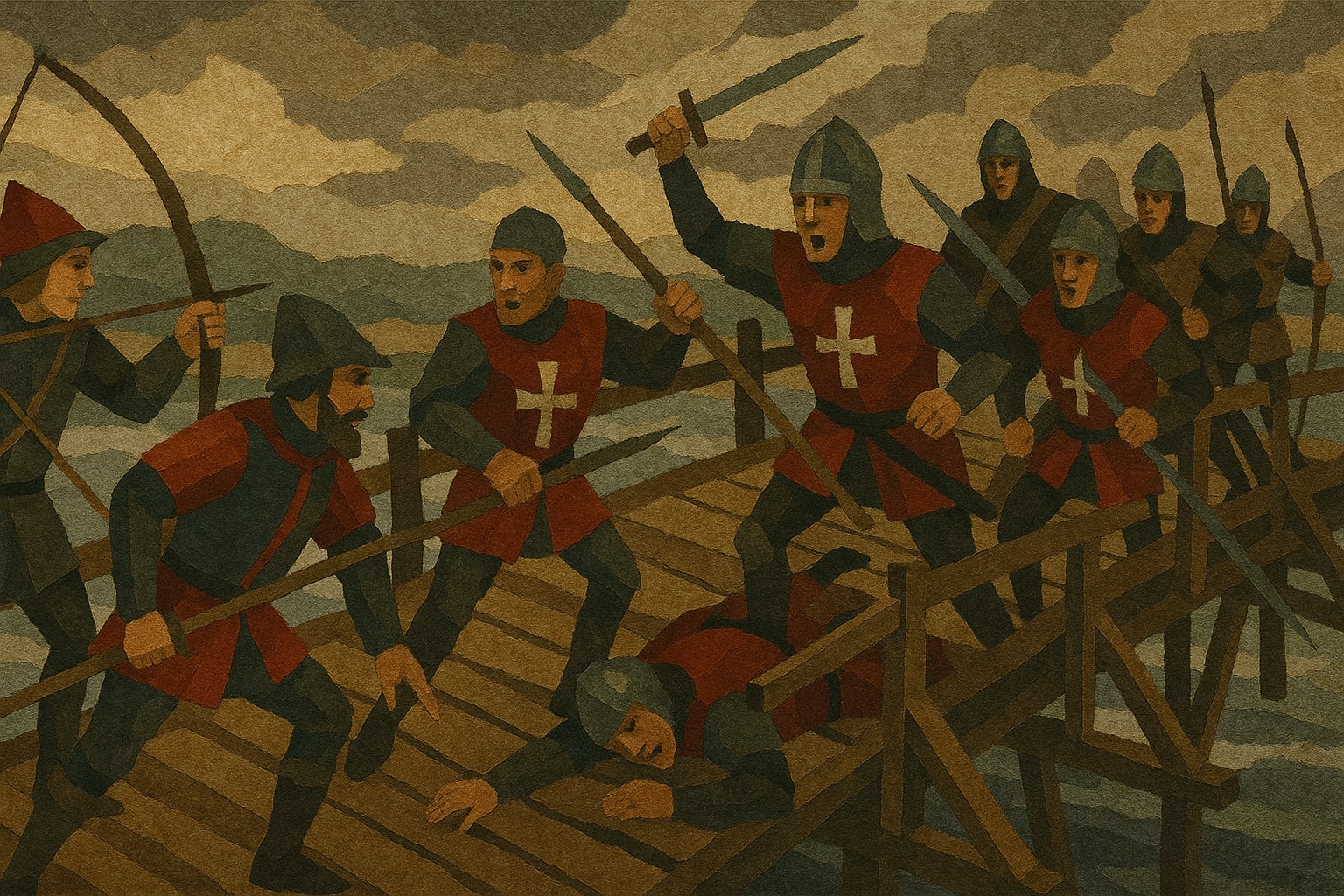
The showdown came on 17 June. Henry VII had around 25,000 men on the field — one of the biggest armies England had seen in years — and the Cornish never really stood a chance. Even so, they put their best archers on the bridge over the Ravensbourne and, at first light, hit the royal vanguard with a brutal hail of arrows. It slowed the king’s men, but not for long. Lord Daubeney pushed across, drove the rebels back up to Blackheath, and was even captured in the chaos for a moment before his troops rescued him.
Alas, An Gof and Flamank were caught, and the rebellion was crushed. Both leaders were executed at Tyburn, with An Gof proclaiming he would have “a name perpetual and a fame permanent.” He was technically right; there’s now a plaque commemorating the rebellion in Blackheath.
So, why did the 1497 rebellion matter? For Henry, it was the moment he learned he could hold a shaky kingdom together by force if he had to. For Cornwall, it became a lasting memory of a blacksmith who led his neighbours across half of England and came closer than anyone expected to making the Tudor crown flinch.
1 December 2025
References
- Cornish Rebellion. EBSCO
- 1497, Cornwall and the Wars of the Roses. Historical Association
- The Cornish rebellions of 1497. Devon Perspectives
- Cornish Rebellion of 1497. Historic UK
- The Battle of Blackheath. Cornwall For Ever
- The Cornish Uprisings of 1497. Richard III Society