Deptford • 1387–2025
Deptford timeline of crime, justice and social unrest
From manor courts and parish constables to fingerprint evidence and CCTV, Deptford has been a testing ground for British justice. Its streets and riverfront have seen rebels and dockyard thieves, pirates and smugglers, prison hulks and bread riots, wartime looting cases and a fire that helped expose institutional racism.

Chaucer mentions Deptford in the Canterbury Tales. Justice was hyper-local then. Manor courts handled neighbourhood disputes, local regulations, and minor offences — the routine business of everyday life. More serious cases went beyond the manor’s reach and were tried in higher royal courts.
Richard Wyche, vicar of St Nicholas Church in Deptford and a known Lollard, refuses to drop his beliefs. He is burned on Tower Hill for heresy, along with Roger Norman, possibly his servant. After their deaths, people begin treating Wyche as a martyr, and the authorities spend years trying to shut it down.
A Cornish rebel army marches across southern England to protest new war taxes and ends up facing Henry VII’s troops at Deptford Bridge. The battle is short; captured leaders are dragged to Tyburn and sentenced to be hanged, drawn, and quartered.
In 1513, Henry VIII establishes the royal dockyard at Deptford to build and maintain his warships. Rope, timber, pitch and other stores kept in the King’s Yard are treated as royal property, and taking them without permission is classed as theft, not a workplace perk.
Elizabeth I comes to Deptford to knight Francis Drake on the deck of the Golden Hind. The ceremony doubles as a legal sleight of hand: Drake’s raids on Spanish ships are effectively pardoned and rebranded as a patriotic enterprise.
Playwright Christopher Marlowe is killed in a Deptford lodging house. An inquest accepts that Ingram Frizer, a government-connected fixer, stabbed him in self-defence during a quarrel over the bill. Frizer is quickly pardoned. No further questions are officially asked, giving later generations plenty of room to suspect that Deptford hosted a secret state-sanctioned assassination.
Samuel Pepys visits Deptford repeatedly as part of his Navy Board duties. He often complains about poor accounting, waste, and lax management across the royal dockyards, and his later reforms focus on tightening contracts, improving record-keeping, and reducing everyday abuses.

Tsar Peter the Great lodges at Sayes Court while studying shipbuilding at Deptford. His entourage reportedly wrecks John Evelyn’s carefully designed garden, smashing hedges and rolling through it in wheelbarrows. The bill for repairs becomes an early modern case study in the limits of diplomatic immunity.
Across the Thames ports, press gangs were the Royal Navy’s tool for filling ships fast. Backed by Admiralty warrants, gangs of armed men prowled taverns and lodging houses, seizing able-bodied men for forced service at sea. In places like Deptford, the threat of being “pressed” was constant, especially in wartime.
In the 1760s, slavery is still legal in Britain, and London’s riverfront is tightly bound to the Atlantic economy that sustains it. Deptford’s yards build and supply ships used in the slave trade, and enslaved Africans brought by naval officers and merchants are a familiar sight along the Thames.
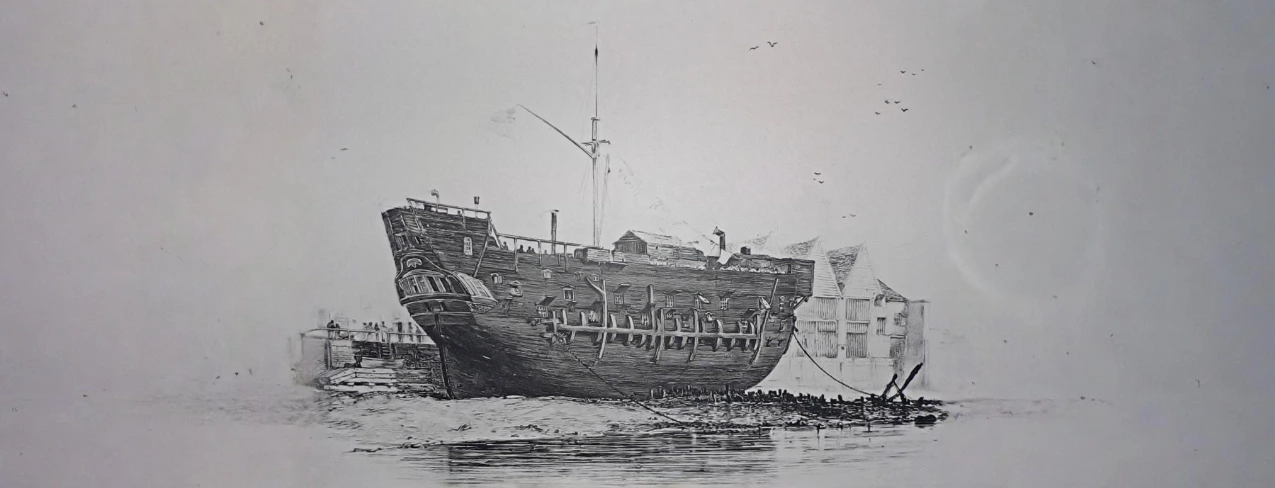
After the loss of the American colonies, Britain turns surplus ships into floating prisons on the Thames. Some lie off Deptford, crammed with convicts living in filthy, airless holds. Reformers report disease, violence and shocking death rates. Between 1776 and 1795, around 2,000 of the 6,000 men held on the hulks die from neglect and disease.
Patrick Colquhoun founds the Thames River Police to combat widespread theft from ships moored in the Pool of London. The new force marks a shift toward organised riverfront policing, aimed primarily at protecting cargo in central London’s docks.
A conman in Deptford pretended to be an Admiralty agent and told a local woman he could sell her “protection” from being pressed into naval service. There was no press gang involved at all. The scam worked because the fear of forced recruitment was so widespread and believable.
Deptford becomes part of the Metropolitan Police District, replacing parish constables and night-watchmen with full-time uniformed officers: the new “Peelers” created under Sir Robert Peel. Their arrival marks a shift toward organised patrols and preventive policing rather than the reactive parish system.
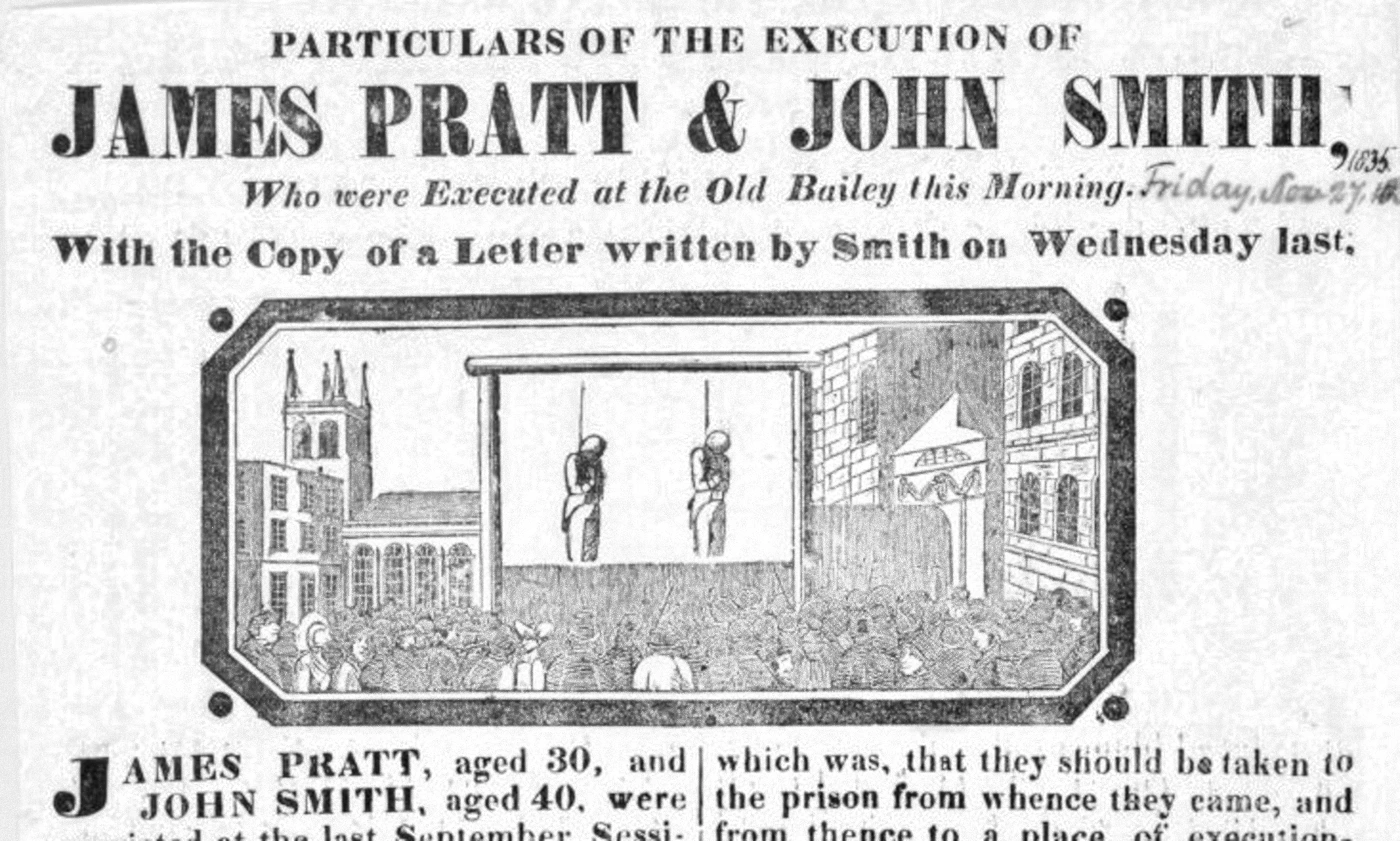
James Pratt, a Deptford resident, and John Smith become the last men in England executed for consensual gay sex between adults. They are caught in a rented room in Southwark after a neighbour claims to peer through a keyhole, and the courts move quickly to make an example of them. The evidence is flimsy, but the outcome is fixed long before the gallows.
A bread riot erupts in Deptford after parish bread handouts at St Paul’s run out. The crowd marches down the High Street, looting one baker, scaring a second into giving everything away, and attacking a third near Deptford Broadway. The next day the rioters come back for the butchers. Local elites later blame “outsiders”, but the magistrate hands down three weeks on “bread and water” to fifteen-year-old William Yarnell, whose employer calls him “obstreperous” and “a perfect terror.”
A Saturday-night crowd gathers on Deptford High Street. Police move in to clear it; stones fly, several constables are injured. At the Old Bailey, officers describe a violent mob, while witnesses insist the trouble begins with drunk, heavy-handed policing. The case exposes the tension between Deptford’s Irish diaspora and the authorities.
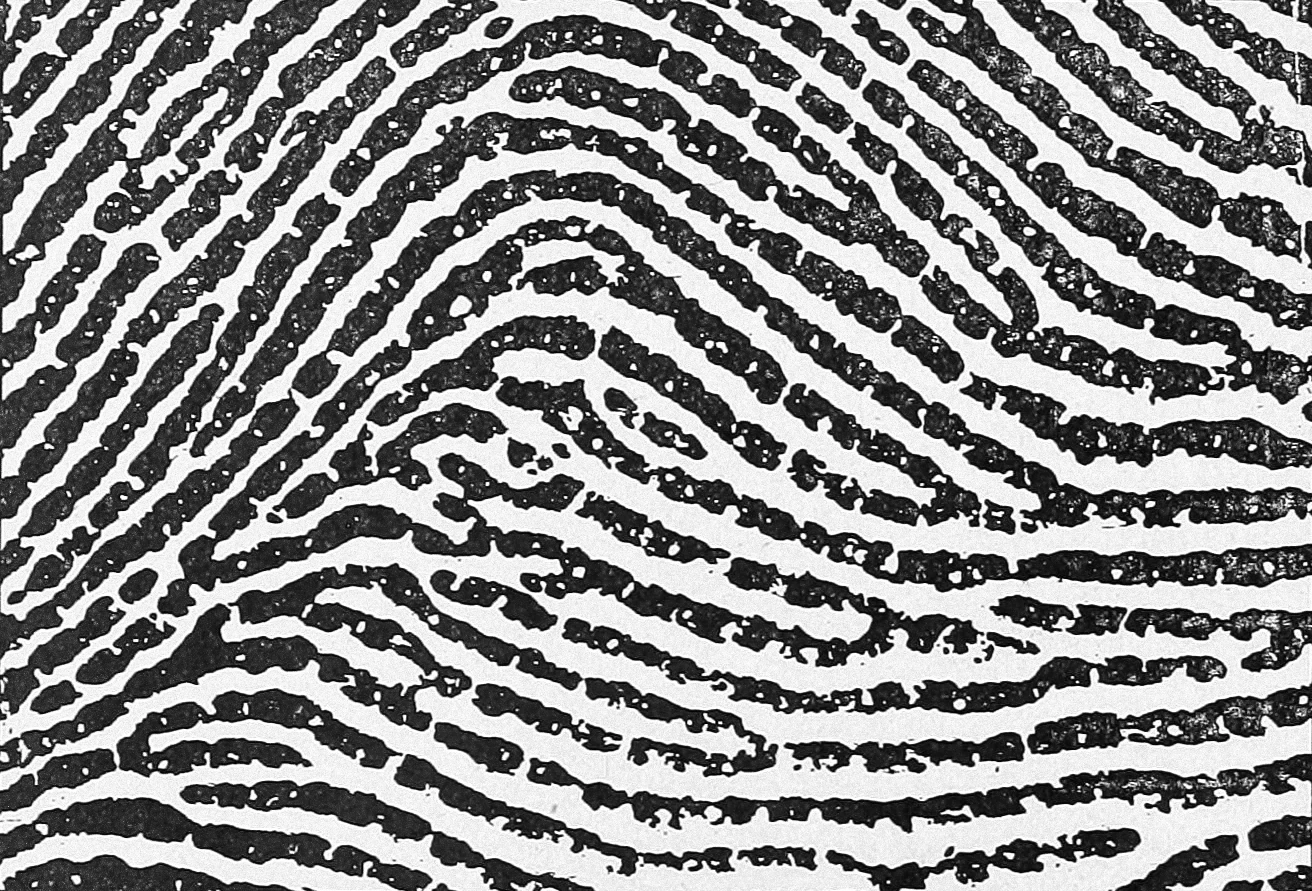
Thomas and Ann Farrow are murdered in their paint shop on Deptford High Street. Detectives find a greasy thumbprint on a cash box and match it to Alfred Stratton, a local petty criminal. Alfred and his brother are mainly convicted on fingerprint evidence: the first time this happens in a British murder trial. The case becomes a milestone in the story of forensic science.
With the start of the war, anti-German riots break out in Deptford. Police try to hold the line on Deptford High Street and several officers are hurt. The New York Times reports around twenty bakeries, butcher shops and saloons smashed, with 100 dock workers leading the attack after being pushed out of their lodging house to make room for Belgian refugees. The violence rolls on for nearly a mile before soldiers finally stop it.
The Blitz and later V-2 attacks hit Deptford hard. The rocket bomb that tears through the Woolworths and Co-op stores on New Cross Road kills more than a hundred people. Rationing rules shape daily life, with food officers and police chasing black-market deals across London, while the blackout gives thieves cover.
A white crowd tries to force its way into Carrington House, a council lodging house in Deptford, where about 40 Black men from Africa and the Caribbean are staying. A clash on the High Street turns into an attack on the hostel. The residents barricade the doors and fight back. Police arrest people from both sides. After two nights of violence, a third night draws 1,500 people, but it stays quiet.
A house fire at a birthday party in New Cross, on Deptford’s fringe, kills 13 young Black people. Many believe it to be a racist arson attack; the investigation is slow; no one is charged. Outrage leads to the Black People’s Day of Action, a huge protest that forces the country to confront the question of institutional racism in policing. Later cases, including Stephen Lawrence’s murder, will echo this moment.
Today, CCTV watches streets where night-watchmen once carried lanterns. Gentrification has brought cafés and co-working spaces, but also new pressures, from cybercrime to drugs. Deptford’s long conversation with law and order goes on.
2 December 2025
References
- The History of Deptford. Nathan Dews
- Turning the Tide: The History of Everyday Deptford. Jess Steele
- The Manor Court. Conisbrough Court Rolls
- The Manor of East Greenwich in the County of Kent. Edward P. Cheyney
- Literary, Legal, and Last Judgments in The Canterbury Tales. Elizabeth A. Dobbs
- A Name Perpetual. Penwith Local History Group
- Richard Wyche, Vicar of Deptford. London Remembers
- The Deptford Royal Dockyard and Manor of Sayes Court, London: Excavations 2000–12. Ann Coats
- The Houses of Henry VIII’s Courtiers in London. Christopher Phillpotts
- Five Hundred Years of Deptford and Woolwich Royal Dockyards. Paula Martin
- Francis Drake Knighted at Deptford, April 4th. Kevin Flude
- Death in Deptford. Marlowe Society
- The Reckoning in Deptford: Unmasking Christopher Marlowe’s Killer. Amy Irvine
- The Royal Navy Under Charles I: Part III — The Administration. M. Oppenheim
- Samuel Pepys and the Navy. Royal Museums Greenwich
- Diary Entry: 8 August 1662. Samuel Pepys
- The Professionalisation of the Royal Navy: 1660–1688. Samantha Middleton
- Russians in London: Peter the Great. Sarah J. Young
- Press Gangs. Alistair Lee
- Chips on Their Shoulders: Deptford Shipwrights’ Strike, 1739. Past Tense
- The Grit in the Oyster: Deptford, Enslavement, and the Challenges of Memorialisation. Helen Paul
- Prison Hulks in Britain: Conditions, Escapes and Reform. Anna McKay
- Hulks. Institutional History Society
- A fate worse than death. Michelle Higgs
- The Thames River Police: Forefathers of Modern Policing. David Wells
- Fraud and the press gang in Deptford Caroline Derry
- Sir Robert Peel. Christopher R. Middleton, Ben Johnson
- The Police of London: The Early History of the Metropolitan Police, 1829–1856. Ronald Charles Sopenoff
- Peelers. Val Czerny
- James and John by Chris Bryant review —– the cost of being gay in 19th century London. Kathryn Hughes
- Pratt & Smith —– Last Men Hanged in England For Gay Sex. Peter Tatchell
- A bread riot in Deptford, 1867. Past Tense
- Police clash with Deptford Irish 1869 . Transpontine
- Baildon Street: The Blackest Street in Deptford?. John Price
- Fingerprint Saw Brothers Hanged for Brutal Murders. London News Online
- The Deptford Murder: First Murder Conviction Using Fingerprints, 1905. Crimes Through Time
- Anti-German Mobs Wreck London Shops. The New York Times
- Deptford, London: Anti-German Riots. BBC
- Anti German Attacks in Deptford in World War I. Running Past
- Poison in the air. Rudolf Rocker
- Delinquent Areas in the County of London: Ecological Factors. C. P. Wallis and R. Maliphant
- The V2 Woolworths rocket bomb disaster 25th November 1944. Goldsmiths History Project
- What You Need To Know About Rationing In The Second World War. Imperial War Museums
- A racist riot in Deptford, 1949. Transpontine
- Men, Violence and Substance Misuse: A Study of White Working Class Masculinities in Deptford. Dean Whittingdon
- The New Cross Fire. Museum of London
- Forty Years On From the New Cross Fire: What Has Changed for Black Britons?. Kehinde Andrews
- The Black People’s Day of Action 40 years on. UCL Sarah Parker Remond Centre
- The Prevention of Crime Against Small Businesses: The Safer Cities Experience. Nick Tilley
- Before Lawrence. Kim Evans
- CCTV Cameras in the Borough. London Borough of Lewisham