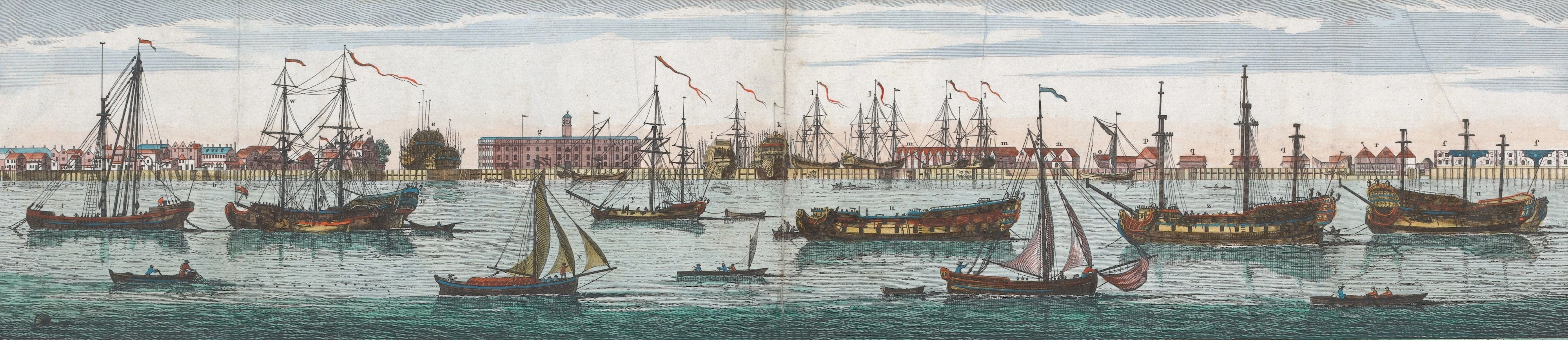
In the mid-1750s, Pierre-Charles Canot, a French engraver working in London, produced views of England’s six Royal Dockyards, including the one in Deptford.
It was part Google Street View, part product catalogue: the riverside panorama showed the Thames frontage, and the state-of-the-art ships on the water promoted what the yard could produce. Canot began work as Britain was mobilising for the Seven Years’ War; Deptford’s slipways had never been busier. The ships built or repaired here fought at Trafalgar, carried James Cook around the world, and kept an empire afloat.
The plan shows the walled dockyard surrounded by open fields, the river and narrow Deptford lanes. King Street, Dog Street, and Butcher Row are still here, almost three centuries later, although we now know them by different names: Watergate, Prince, and Borthwick Streets. You can actually walk these streets today along the dockyard’s wall.
Inside, the Great Storehouse was the centrepiece: a large courtyard building that also appears in the panorama as the dominant landmark on the skyline, its clock tower and cupola visible from the Thames. Around it were the working parts of the yard: dry docks and slipways where hulls were built and repaired, a wet dock for moored vessels, and the long mast houses where timber was stored and shaped. Sayes Court, John Evelyn’s former manor house, sat just outside the northern wall. Peter the Great lodged here in 1698 while studying shipbuilding. By 1755, it was a workhouse for the poor.
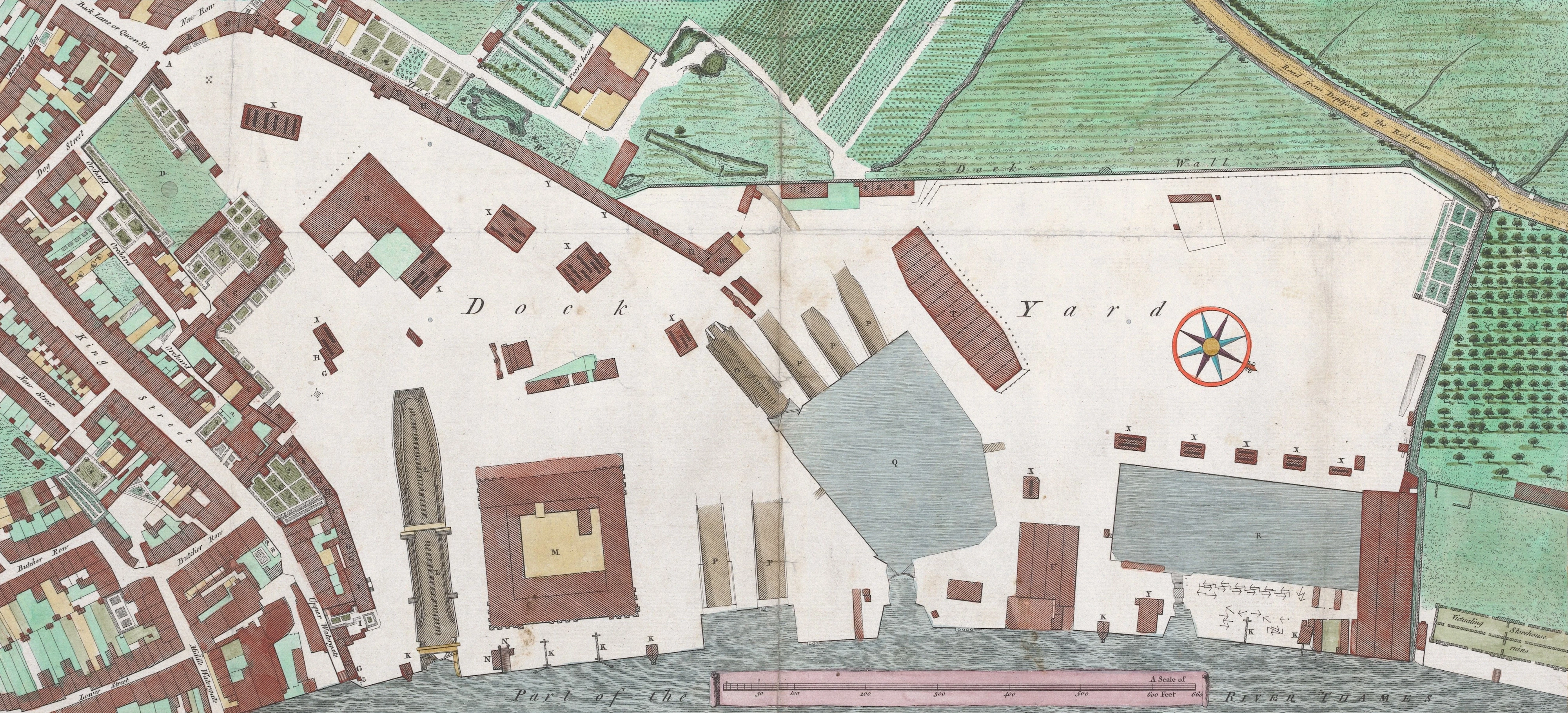
The yard that Canot recorded so carefully finally closed in 1869, a casualty of steam power and deeper-drafted ships that Deptford’s shallow Thames bend couldn’t accommodate. Most of it is gone: the Great Storehouse demolished in 1954, its bricks used for garden walls at Hampton Court Palace; the adjacent storehouses cleared in 1984. A couple of buildings survive, including the Master Shipwright’s House — currently on the market for £8,000,000. The clock and cupola from the old Great Storehouse ended up in Thamesmead, which feels about right.

Below ground, the slipways, dry docks and mast ponds are still there, studied in archaeological digs. The Tudor foundations are now a Scheduled Ancient Monument, which is a very British way of saying: we knocked everything down, but we’re quite protective of the hole.
References
- A Geometrical Plan, & North East Elevation of His Majesty’s Dock-Yard, at Deptford, with Part of the Town. Yale Center for British Art, Paul Mellon Collection
- At Deptford with part of the town. Wikimedia Commons
- Tudor naval storehouse at Convoys Wharf. Historic England
- Deptford, St Nicholas. British History Online
- Convoy’s Wharf uncovered. Caroline Derry
- Deptford Dockyard: oldest remains discovered . Greenwich Industrial History

Support my work by subscribing to Hypertextual, a newsletter about science and big ideas.